
Peraturan Pemerintah Nomomor 20 Tahun 2026 (PP 20 of 2026): What UMKM Business Owners Need to Know About Indonesia’s New Final Income Tax Rules (PPh)?
The Government of Indonesia recently issued Government Regulation No. 20 of 2026 (“PP 20/2026”), which amends Government Regulation No. 55 of 2022 regarding Income Tax arrangements. At first glance, many business owners may assume that the regulation simply concerns the continuation of the 0.5% final income tax rate for UMKM taxpayers. However, PP 20/2026 introduces several important changes that may affect business structuring, tax planning, and compliance obligations.
What Has Changed?
Under the previous framework, various forms of business entities could access the 0.5% final income tax regime for a limited period, provided that their annual gross turnover did not exceed Rp4.8 milyar.
Under PP 20/2026, the government narrows the scope of taxpayers eligible for the 0.5% final tax regime.
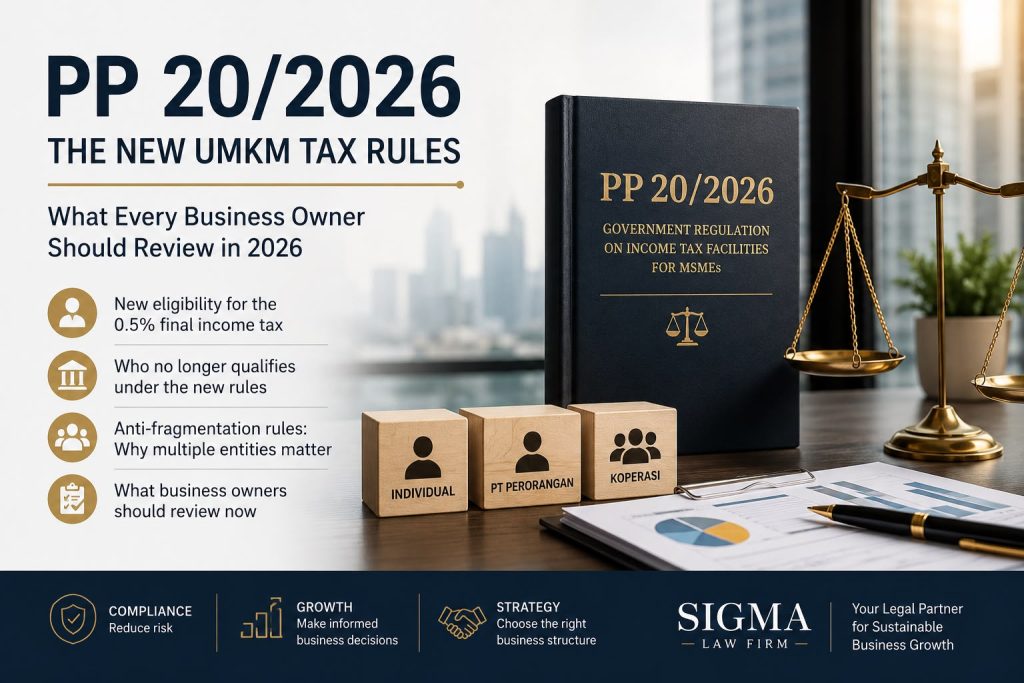
The facility is now generally available only to:
- Individual taxpayers conducting business activities;
- Individual-owned Limited Liability Companies (Perseroan Perorangan); and
- Koperasi.
Meanwhile, entities such as CVs (Commanditaire Vennootschap), Firms (Firma), and ordinary Limited Liability Companies (Perseroan Terbatas) are no longer included as new beneficiaries of the regime and will generally be subject to the ordinary income tax system after their transition period expires.
Why Was This Change Introduced?
According to the government’s explanation, one of the objectives of PP 20/2026 is to ensure that the simplified tax facility reaches genuine small business operators while reducing opportunities for tax avoidance through artificial business fragmentation.
In practice, some taxpayers could establish multiple entities and divide business activities among them to keep each entity below the turnover threshold. The new regulation introduces rules intended to prevent such arrangements from obtaining benefits beyond the original purpose of the UMKM tax facility.
What Does This Mean for Business Owners?
For genuine UMKM operators, the regulation provides greater certainty and continued access to a simplified taxation mechanism.
However, business owners should carefully review:
- The legal form of their business;
- The ownership structure of related entities;
- Annual turnover across multiple businesses;
- Future expansion plans and tax implications.
The choice between operating as a sole proprietor, Perseroan Perorangan, CV, Koperasi, or ordinary PT may now carry different tax consequences than under the previous framework.
Key Takeaway
PP 20/2026 should not be viewed solely as a tax amendment. It is also a business structuring and compliance reform.
Business owners are encouraged to review their current corporate structure and tax position to ensure continued compliance and to evaluate whether their existing business vehicle remains the most suitable for future growth.
Sigma Law Firm continues to monitor regulatory developments affecting Indonesian businesses and remains available to assist clients in assessing the legal and tax implications of these changes.