
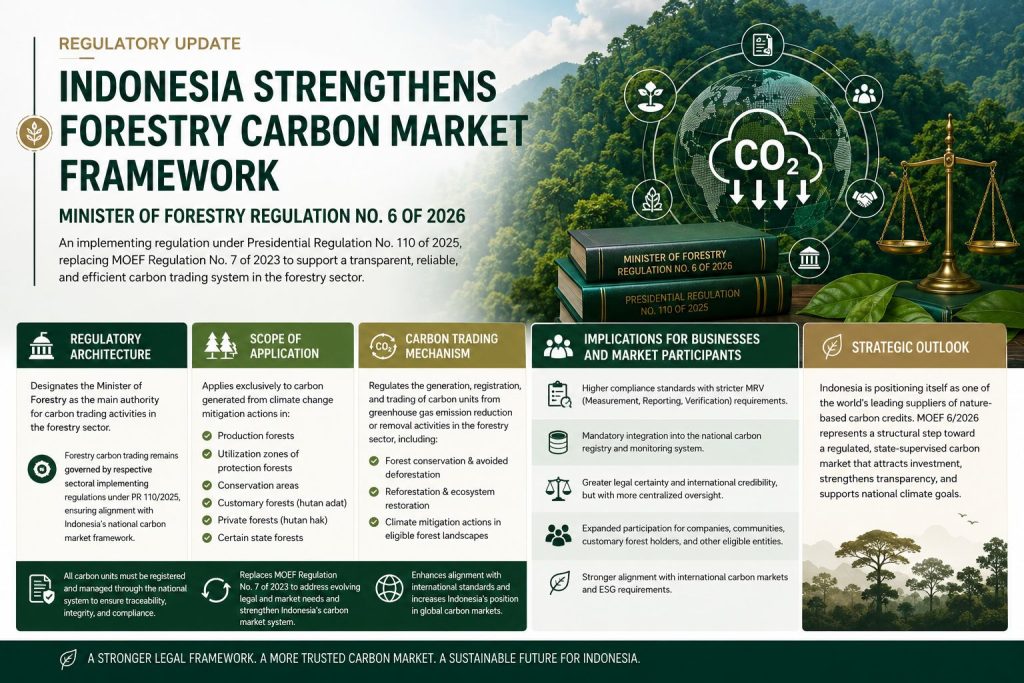
Indonesia has issued Minister of Forestry Regulation No. 6 of 2026, an implementing regulation under Presidential Regulation No. 110 of 2025, strengthening the legal and operational framework for carbon trading in the forestry sector. This regulation replaces MOEF Regulation No. 7 of 2023, reflecting the need to align Indonesia’s carbon market system with evolving domestic and international market standards.
- Regulatory Architecture and Governance Shift
MOEF 6/2026 confirms the Minister of Forestry as the primary authority for carbon trading activities derived from forestry-based emission reduction and removal projects.
At the same time, forestry carbon trading remains governed by its respective sectoral implementing regulations under PR 110/2025, ensuring alignment with Indonesia’s broader national carbon trading system and cross-sector carbon governance framework.
This creates a dual-layer structure:
- Sector-specific governance (forestry authority and rules)
- National integrated carbon market framework (PR 110/2025 system)
- Scope of Application
The regulation applies exclusively to forestry-based carbon activities, including:
- Production forests
- Protected forest utilization zones
- Conservation areas
- Customary forests (hutan adat)
- Private forests (hutan hak)
- Selected state forest areas
Carbon credits originate from emission reduction and removal activities within these eligible forest categories.
- Carbon Trading Mechanism
MOEF 6/2026 regulates the generation, registration, and trading of carbon units derived from:
- Forest conservation and avoided deforestation
- Reforestation and ecosystem restoration
- Climate mitigation actions within eligible forest landscapes
All carbon units must be registered within the national system to ensure traceability, integrity, and compliance.
- Replacement of MOEF 7/2023
This regulation replaces MOEF 7/2023 to:
- Strengthen measurement, reporting, and verification (MRV) systems
- Improve integration with Indonesia’s national carbon registry
- Increase alignment with international carbon market standards
- Enhance regulatory clarity and enforcement capacity
- Implications for Companies and Market Participants
a. Centralized compliance framework
All forestry carbon projects must comply with a government-controlled registration and verification system.
b. Mandatory integration into national registry
Carbon credits must be recorded and tracked within the official carbon registry infrastructure.
c. Stronger legal certainty, reduced structural flexibility
While market credibility increases, project structuring and trading mechanisms are more tightly regulated.
d. Broader participation base
Inclusion of corporations, communities, customary forest holders, and eligible private actors under regulated access pathways.
e. Enhanced alignment with international carbon markets
The framework improves transparency and strengthens Indonesia’s position in global carbon credit markets.
- Strategic Outlook
Indonesia continues positioning itself as a major global supplier of nature-based carbon credits. MOEF 6/2026 represents a structural shift toward:
- A regulated and centralized carbon market system
- Improved international market confidence
- Stronger ESG and climate compliance integration
Companies entering this sector should expect:
- Higher compliance and documentation requirements
- Increased reliance on verified MRV systems
- Longer regulatory approval cycles under centralized oversight