


Legal Insight
Indonesia has recently revised its visa-free entry policy by limiting visa-free access to a smaller group of countries while requiring many foreign nationals to obtain a Visa on Arrival or another appropriate visa before entering the country.
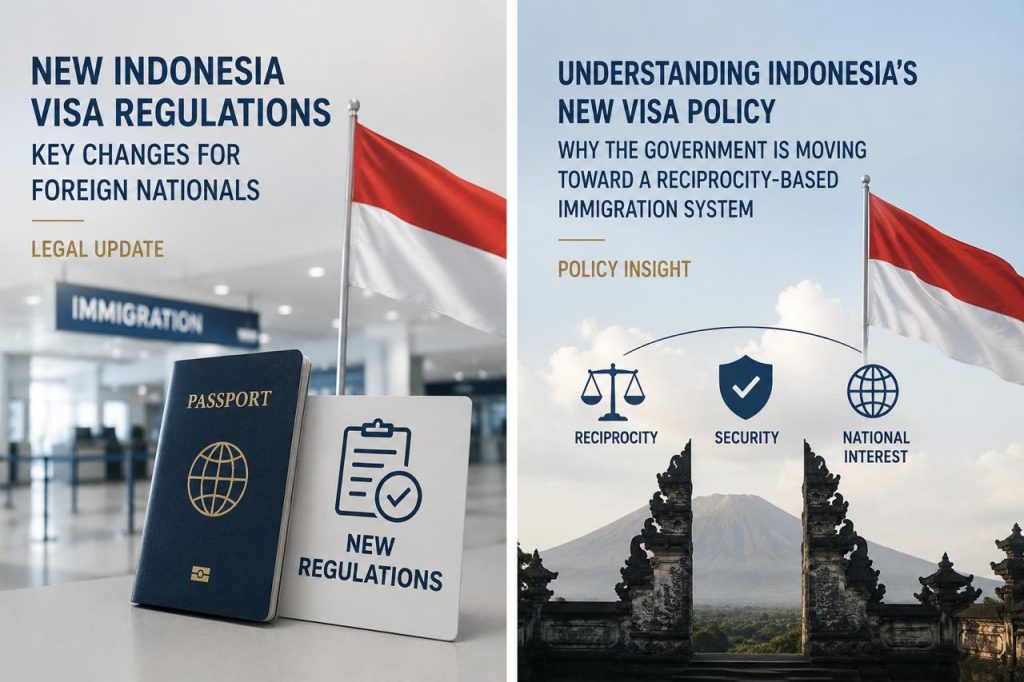
Although this change has generated considerable public attention, it is important to understand that the policy is not intended to discourage international visitors. Rather, it reflects a broader shift in Indonesia’s immigration philosophy toward reciprocity, national interest, and effective immigration governance.
From an Open-Door Policy to a Selective Immigration Framework
For many years, Indonesia maintained one of the world’s most generous visa-free entry policies. Citizens of numerous countries could enter Indonesia without obtaining a visa, supporting tourism and facilitating international travel.
The current policy represents a strategic shift. Instead of extending visa-free access broadly, the Government now applies a more selective approach, evaluating whether visa-free treatment serves Indonesia’s diplomatic, economic, and security interests.
The Principle of Reciprocity
One of the principal considerations underlying the revised policy is reciprocity.
In international law and diplomacy, reciprocity refers to the practice of extending comparable treatment to another country’s citizens when that country provides similar treatment to one’s own nationals. By adopting a reciprocity-based approach, Indonesia seeks to ensure that immigration privileges are granted in a manner that reflects balanced bilateral relationships rather than unilateral concessions. While reciprocity does not necessarily require identical visa policies between countries, it has become an increasingly important consideration in Indonesia’s immigration decision-making.
National Interest Beyond Tourism
Visa policy is not solely a tourism instrument. It is also a mechanism for protecting national interests. When determining whether visa-free entry should be granted, governments commonly assess a range of considerations, including economic benefits, investment opportunities, migration patterns, border security, immigration compliance, and diplomatic relations.
Indonesia’s revised framework reflects this broader perspective by balancing the objective of welcoming legitimate visitors with the responsibility to maintain effective immigration control.
What Does This Mean for Foreign Visitors?
For most foreign nationals, the practical impact is relatively limited. Many visitors who previously entered Indonesia without a visa remain eligible to obtain a Visa on Arrival or an Electronic Visa on Arrival. While this introduces an additional administrative step and government fee, travel to Indonesia remains readily accessible for eligible visitors.
Accordingly, the revised policy should be understood as a recalibration of immigration procedures rather than a restriction on international travel.
Looking Ahead
Indonesia’s recent immigration policy demonstrates a growing emphasis on selective visa facilitation grounded in reciprocity, national interest, and sound immigration governance. As international mobility continues to evolve, businesses, expatriates, investors, and foreign visitors should remain informed of regulatory developments and verify applicable visa requirements before travelling.
Professional legal advice can help ensure compliance with Indonesia’s immigration framework and avoid unnecessary delays or complications.
Sigma Legal continues to monitor developments in Indonesian immigration law and remains available to assist individuals and businesses with visa applications, immigration compliance, and cross-border legal matters.