


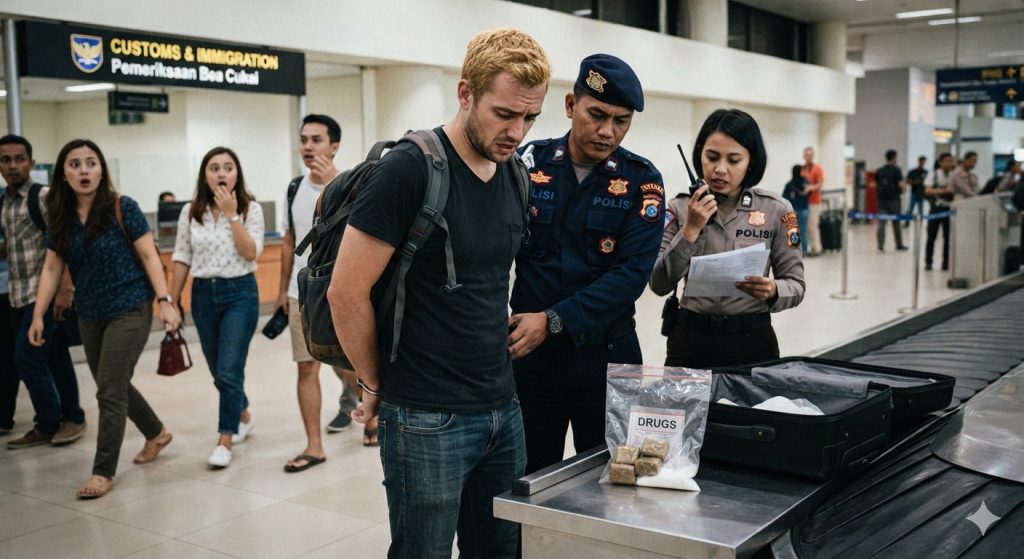
Being arrested at an Indonesian airport can be an extremely stressful experience, particularly for a foreign national who may be unfamiliar with Indonesian criminal procedure, unable to communicate fluently in Bahasa Indonesia, or uncertain about what will happen next.
If you or someone close to you has been arrested in Indonesia in connection with an alleged drug offence, it is important to understand that the criminal process is governed by Indonesian law and that legal assistance should be obtained as early as possible.
This article provides a general overview of some of the immediate legal considerations for foreign nationals facing arrest in Indonesia.
The first question is whether the arrest has been carried out in accordance with Indonesian criminal procedure. Indonesia’s current criminal procedure framework is governed by Law Number 20 of 2025 on the Criminal Procedure Code, which came into force on 2 January 2026. The new KUHAP replaced Law Number 8 of 1981.
Under the new KUHAP, an arrest is a temporary restriction of a person’s liberty for the purposes of the criminal process. Arrest must be based on the legal requirements established by the KUHAP, including the existence of at least two items of evidence.
An arrested person should therefore be informed of the basis for the arrest and the alleged offence. The investigator is also required to follow the formal requirements concerning the arrest warrant and provide the relevant information to the arrested person’s family or designated person within the period prescribed by law.
The second important step is to obtain legal assistance.
A person who is arrested or investigated in Indonesia should seek assistance from an Indonesian advocate who can communicate directly with the investigating authorities and protect the person’s procedural rights throughout the investigation.
For a foreign national, this can be particularly important. Criminal procedure, terminology, documentation and investigative practices may be unfamiliar, and communication difficulties can create additional risks.
The choice of lawyer also matters.
A detained person should be able to make an informed decision about who will represent or assist them. Where possible, the individual or their family should have the opportunity to select an advocate whom they trust and with whom they can communicate comfortably.
This is particularly important in a serious criminal investigation, where the lawyer may need to assist with communication with investigators, review procedural documents, accompany the client during examinations, advise the client regarding their legal rights and obligations, and coordinate with the family and, where appropriate, the relevant embassy or consular authorities.
There are also several practical steps that a foreign national or their family should consider immediately after an arrest.
- Request an interpreter
First, if the person does not sufficiently understand Bahasa Indonesia, they should request an interpreter or appropriate language assistance. Basic conversational ability may not be sufficient to understand formal legal questions, statements, procedural documents, or the consequences of particular answers.
2. Request Consular Notification
Second, an arrested foreign national may request consular notification and access to their embassy or consulate. Consular assistance does not replace legal representation by an Indonesian advocate, but it may provide an additional channel of support concerning the person’s welfare, communication, and consular rights.
3. Do Not Sign Unread Document
Third, a person should not sign a document that they do not understand. If a document is presented for signature, the person should ask for an explanation or interpretation and, where appropriate, seek legal advice before signing. Understanding what is contained in a statement or other procedural document is particularly important during an ongoing criminal investigation.
These practical safeguards are important because a foreign national may be dealing with an unfamiliar legal system, language barriers, and significant stress at the same time. Having appropriate legal and language assistance can help the person understand what is happening and make informed decisions throughout the process.
4. Seek for Legal Advice / Lawyer
Avoid making uninformed decisions during the investigation. Most importantly, do not wait until the case reaches court before seeking legal advice.
A person facing an alleged drug offence should not assume that a matter can be resolved simply because they are a foreign national or because the alleged offence occurred at an airport. Drug offences in Indonesia are treated seriously, and the potential legal consequences can be severe.
At the same time, an allegation is not the same as a final determination of criminal responsibility. The circumstances of the arrest, the alleged possession, the nature and quantity of the substance, the available evidence, the chain of custody, the manner in which the evidence was obtained, and the procedural steps taken by law enforcement may all become relevant to the defence.
For that reason, early legal assessment can be critical.
If the arrested person is a foreign national, the family should also consider contacting the person’s embassy or consulate. Consular assistance does not replace Indonesian legal representation, but it may provide an additional channel of support concerning the person’s welfare, communication and consular rights.
The earlier an independent Indonesian criminal defence lawyer becomes involved, the sooner the lawyer can assess the circumstances of the arrest, review the available documentation, communicate with the investigating authorities, advise the client and family, and determine the appropriate legal strategy.
If you or a family member is a foreign national who has been arrested or detained in Indonesia in connection with an alleged criminal offence, obtaining prompt advice from an Indonesian lawyer can help ensure that your legal rights are properly understood and protected from the earliest stage of the process.