

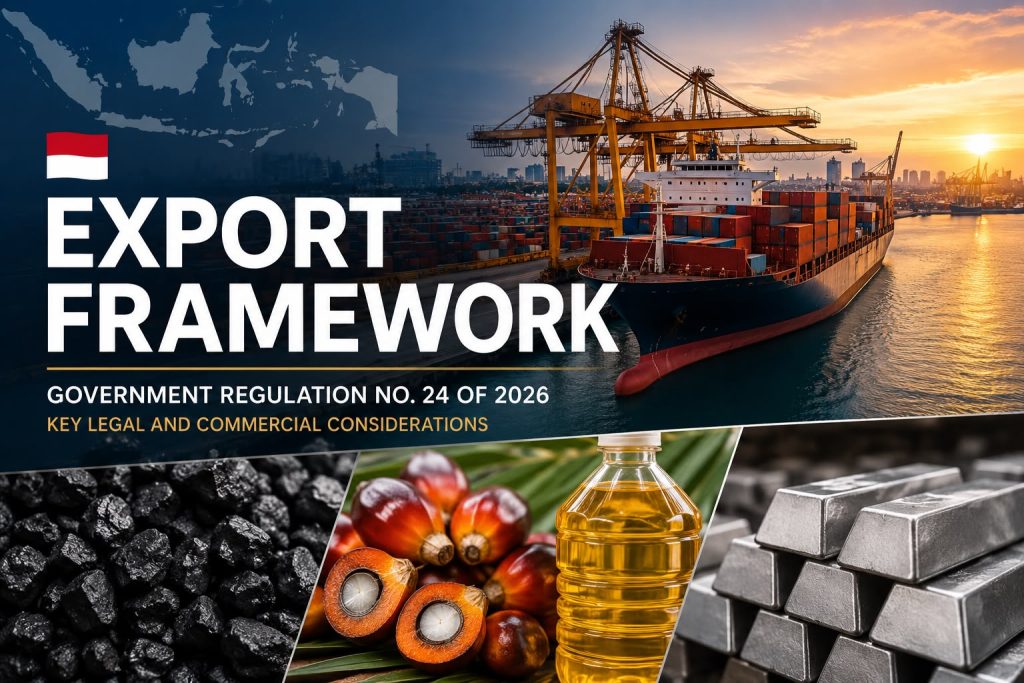
Indonesia’s export governance landscape is undergoing a significant transformation. Government Regulation No. 24 of 2026 introduces a new export centralization framework that is expected to reshape the export of designated strategic natural resources through the involvement of appointed state-owned enterprises (SOEs) in the export chain.
The regulation is expected to affect selected strategic commodities, including coal, crude palm oil and ferroalloys. Businesses operating within these sectors should carefully assess whether their products and export arrangements fall within the scope of the new framework. At the same time, market participants should be aware that the list of affected commodities may expand in the future as the Government continues to develop its strategic resource governance policies.
The regulation provides for a transitional implementation period running from June 2026 through December 2026. During this period, the Government and appointed SOEs are expected to establish the operational, contractual, and administrative mechanisms necessary to facilitate the transition to the new export model. Following the conclusion of the transition period, the framework is expected to become fully operational.
Accordingly, affected businesses should use the transition period proactively. Producers, exporters, buyers, financiers, and investors should begin reviewing their contractual arrangements, financing structures, and supply chain operations now in order to identify potential implementation risks and prepare for the new regime.
From Independent Exporters to Domestic Suppliers
One of the most significant changes introduced by the new framework is the anticipated shift in the role of producers of designated strategic natural resources. Producers that currently export directly to international buyers may transition into suppliers of SOEs which would then assume responsibility for export activities and relationships with international buyers.
This structural change extends beyond regulatory compliance and may require businesses to reassess existing commercial arrangements, financing structures, risk allocation mechanisms, and long-standing customer relationships.
Implementation Risks to Watch
Although the regulation is now in force, the practical migration of Indonesia’s strategic resource export trade to an export state-owned enterprise model presents considerable legal and commercial complexity. The manner in which the Government and SOEs sequence and implement this transition will materially affect producers, international buyers, lenders, investors, and other stakeholders. Several issues are likely to require careful consideration.
Existing Contractual Arrangements
Many existing export transactions are governed by long-term offtake agreements containing detailed provisions relating to product specifications, delivery schedules, pricing mechanisms, payment terms, force majeure protections, change-in-law clauses, and dispute resolution procedures. To the extent that SOEs become mandatory participants in export transactions, existing contracts may require amendment, assignment, novation, or renegotiation.
Such processes may raise a number of legal and practical issues, including obtaining counterparty consent, determining the allocation and treatment of accrued rights and obligations, preserving contractual continuity during the transition period, and managing potential disputes arising from changes to contractual arrangements.
Project Financing and Security Structures
The transition may be especially complex where export contracts form part of project financing arrangements. In many natural resource and infrastructure projects, long-term offtake agreements constitute critical revenue-support arrangements relied upon by lenders and investors. Any amendments, assignments, or novations of these agreements may trigger lender consent requirements, security reviews, cross-default provisions, or other financing-related obligations.
Businesses should therefore carefully assess the interaction between the new export framework and existing financing arrangements at an early stage, particularly where export proceeds are a key component of repayment structures or security packages.
Commercial Terms and Counterparty Reassessment
Where an export state-owned enterprise assumes the role of seller or exporter, international buyers may seek to revisit commercial terms to reflect the revised transaction structure and perceived counterparty risk. This may include adjustments to pricing mechanisms, payment terms, credit support requirements, performance guarantees, liability allocation, and dispute resolution frameworks.
In practice, this may lead to broader commercial renegotiations beyond pure regulatory compliance, particularly in established supply relationships where pricing and risk allocation have historically been stable.
Margin Allocation and Economic Structure
A further area of uncertainty concerns the allocation of economic value across the export chain. At present, the regulation does not appear to provide detailed guidance on how margins will be distributed between domestic producers, designated export state-owned enterprises, and end buyers.This lack of clarity may create practical challenges in negotiations, particularly with sophisticated international counterparties that require transparent and predictable pricing structures. How this economic model is ultimately structured will be critical not only for commercial viability, but also for the ability of the export SOEs to compete effectively in international markets.
Looking Ahead
Government Regulation No. 24 of 2026 represents a significant shift in Indonesia’s export governance architecture. While the policy direction is now clear, many operational and commercial aspects of implementation remain to be clarified.
The transition period running through December will be particularly important. It is during this window that contractual realignment, operational restructuring, and institutional arrangements are expected to be developed and tested.
Businesses are strongly encouraged not to adopt a passive approach during this period. Early identification of affected contracts, proactive engagement with counterparties, and structured review of financing arrangements will be essential to managing legal, commercial, and operational risk.
Sigma Law Firm continues to monitor developments relating to Indonesia’s export centralization framework and is available to assist clients in assessing the implications of the new regime on their contracts, transactions, and financing structures.